
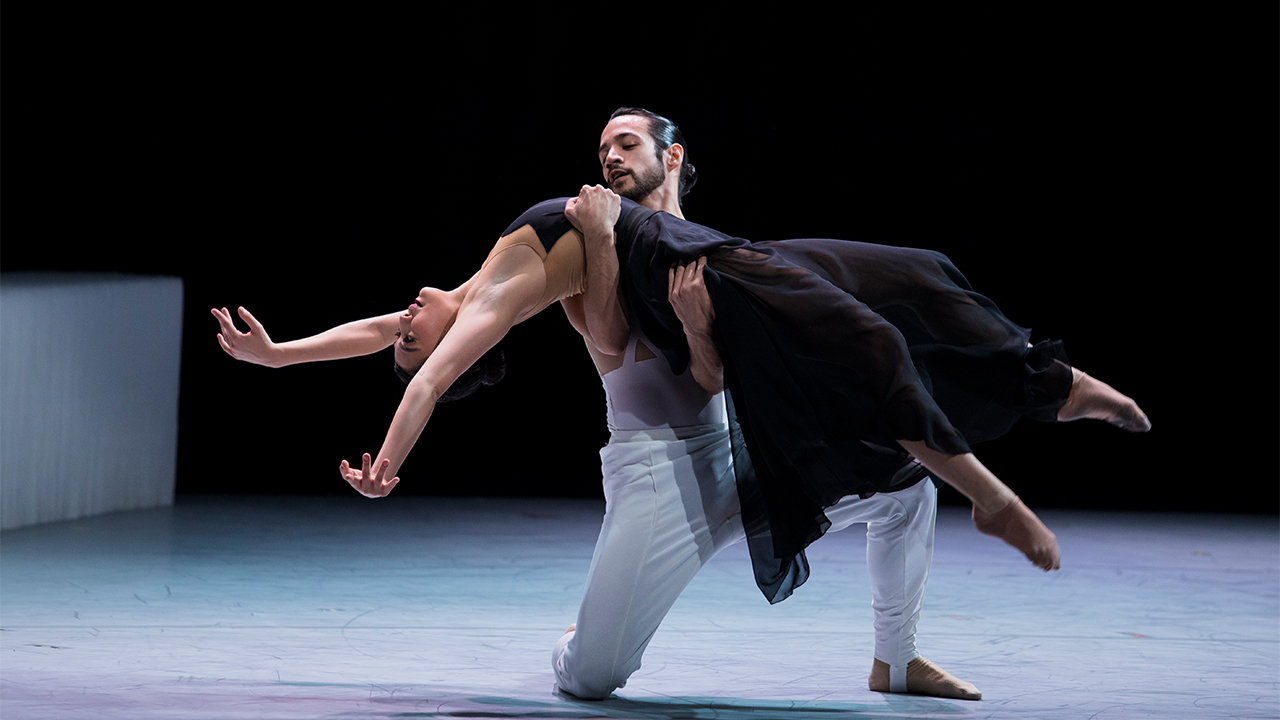
Over a century since its creation in 1875, Georges Bizet’s Carmen remains a poignant and relevant tale that resonates deeply. The fiery tale of a woman who yearns for love but ignites obsession and jealousy in her wake stands as one of the most popular and electrifying operas ever written. Now, on Oct 7, acclaimed choreographer Gustavo Ramírez Sansano and the incomparable Ballet Hispánico bring the fire and elegance of Bizet’s most celebrated opera into a stark, sculptural world of dance in CARMEN.maquia with a daring new narrative.
In this full-length ballet rendition, Carmen becomes an allegory for rebellion and autonomy, her movements a declaration of individuality and passion. Sansano’s choreography draws not only from Bizet’s opera but also from lesser-known works and modern reinterpretations of the music, creating a soundtrack that matches the complexity and nuance of the character herself. Inspired by tauromaquia (the art of bullfighting), the choreography brings a fresh, daring, and intimate perspective to the story.
“The story of Carmen is always present in our lives because we continue to live in a machismo world,” says Sansano. “So, the fact that we are reminded that a woman can behave like a man or have the same freedom is a story that continues to resonate in our minds because it remains relevant. She was a young person at an age where you want to try many things and don’t really think about the consequences, especially the impact on others. That’s the only criticism one could have against Carmen.”
Essentially, CARMEN.maquia entices audiences to see Carmen not as a relic of operatic history but as an ever-relevant symbol of strength and defiance.
“We are in the midst of the 150th anniversary for Carmen, so it was very important for this organization to pay homage to that heroine, to that icon that is ingrained in all of Latin America,” says Ballet Hispanico Director, Eduardo Vilardo. “This is a story of a community of people being together and against each other, which is so fascinating for today’s moment.”
This is more than a performance—it’s a conversation between past and present, a visceral tribute to a story that has shaped and been shaped by culture for over a century.
CARMEN.maquia unfolds on a minimalist stage—a blank canvas inspired by Pablo Picasso’s love of both Carmen and the bullring. Against this backdrop, the dancers’ bold forms and fluid movements carve stories into space, merging ballet, paso doble, and flamenco with contemporary shapes. Costumes, designed by Spain’s David Delfin, reject traditional red and polka dots in favor of understated whites that evoke flamenco’s raw beginnings.
“It wasn’t so much that Carmen is recognizable in Picasso, but rather Picasso is recognizable in Carmen. I discovered that Picasso had a true obsession with the female figure of this untamable character,” says Artistic Director, Luis Crespo. “As I reflected on all of this, I began to see that Carmen is, in fact, a noble character, an untamable one, a fierce spirit, who ultimately ends up being subdued by masculinity. I found this concept so compelling that I wanted to merge the ideas and connect them through Picasso and his work.”
Directed by Ballet Hispánico’s Eduardo Vilaro and choreographed by visionary Gustavo Ramírez Sansano, this reimagined tale strips Carmen of her clichés, presenting her instead as a force of nature: untamed, defiant, and deeply human. Through movement and abstraction, CARMEN.maquia draws us into its orbit—a meditation on identity, power, and the enduring allure of a woman who refuses to be defined.
A love story without compromise—CARMEN.maquia comes to The Lincoln Center in Fort Collins on October 7, 2025. Tickets are available at LCtix.com.